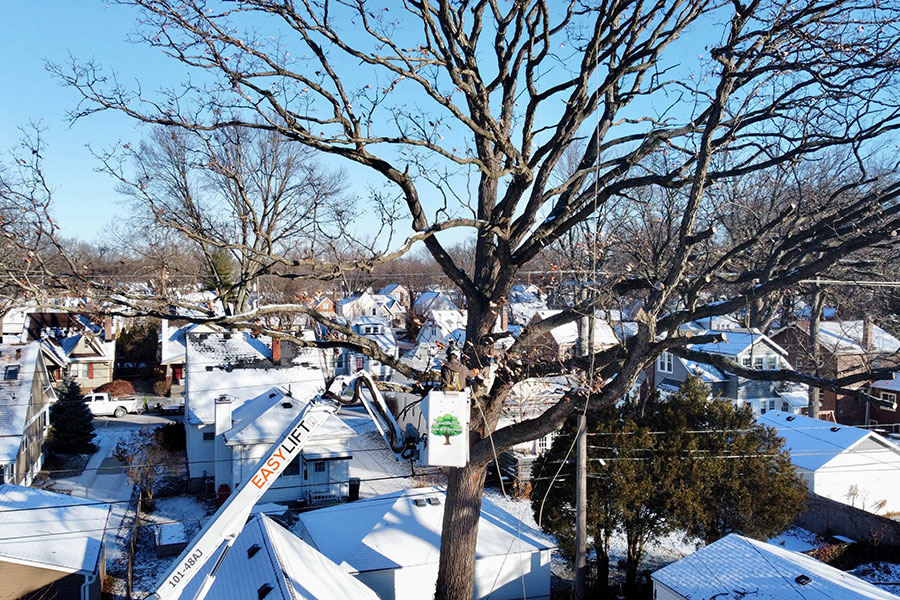
A common misconception we encounter with customers is that trees can be trimmed at any time, especially during spring or summer. While many trees can tolerate pruning at different times, two commonly recognized tree species have different guidelines for preservation. These trees- oaks and elms- should only be trimmed during their dormant season in winter.
In this reading, we explain how dormancy is critical for safe tree trimming of oak and elm trees and what factors influence this restriction.
Understanding Tree Trimming Timing and Dormancy
The most suitable time to trim oak and elm trees is during dormancy. Dormancy is a period when trees are not actively growing; this typically occurs between November and March in Michigan.
It is best to limit trimming oak and elm trees during this time period, or more specifically, after the leaves have dropped in fall and before new buds swell in spring.
Fresh pruning cuts act like open wounds, especially during warmer months when insects are most active, increasing the risk of spread. When trimming trees during dormancy, this minimizes the risk of pests entering through wounds caused by cuts and allows trees to use the entire growing season to close the wounds.
Why Oak Trees Must Be Trimmed During Dormancy
Oak trees are highly susceptible to a fungal disease called Oak wilt. Oak wilt is a fatal fungal disease, most active between April and July, that can kill a mature tree in a single season.
According to the Michigan Oak Wilt Coalition, “Oak Wilt and the causal fungus were first described in Wisconsin in the early 1940s; however, symptoms typical of oak wilt were
described as far back as the late 1800s, even if the cause was unknown at that time.”
Oak wilt is spread by sap-feeding beetles that can enter the tree through root-to-root transmission or through fresh open wounds, which are caused by fresh cuts or when storm damage occurs
(i.e., broken or snapped branches/limbs that cause cracks or holes in the bark). This allows spores, the reproductive form of the fungus, to enter. Spores will plug a tree’s water vessels,
causing leaves to lack proper nutrients and fall off, leading to the tree’s death. In simpler terms, it
will dehydrate the tree. To help prevent the spread of this disease, it is recommended to trim oak trees between November and March, when beetle activity is reduced, and to promote faster healing of open wounds once growth resumes in the spring.
Pruning oak trees during spring or summer can unintentionally put them at serious risk. During this period, disease-carrying insects are highly active and can be attracted to the fresh wounds. This can turn maintenance intended to benefit the tree into a health issue if Oak wilt spreads, leading to premature death.
Why Elm Tree Trimming Is Also Essential During Dormancy
Elm trees also run into a similar threat from Dutch Elm Disease. Brian Colter, a local certified arborist and former City Forester for Grosse Pointe Park, MI, explains, “It was unintentionally introduced from Europe in imported elm lumber around 1930. It was first diagnosed in Grosse Pointe Park in 1951. Today DED is present in much of the continental United States and is responsible for the death of over 80 million trees.”
Dutch elm disease has a similar spread method to Oak wilt; elm bark beetles will carry reproductive fungus from an infected tree to a healthy one, allowing the disease to spread. As the fungus continues to grow, it will dominate the water intake by “blocking” the tree’s nutrients.
This causes the leaves to turn yellow and fall off, leading to the tree’s premature death.
Elm bark beetles are most active during warmer months and can enter through fresh tree wounds or tree root grafts (root-to-root transmission). Trimming elm trees during dormancy can help prevent the spread of Dutch elm disease, while it can also help wounds to heal during the growing seasons.
Dormancy is Crucial
Not only is it safe, if not better timing, to trim oaks and elms in the winter, but it is also crucial for their survival. Proper trimming techniques and timing can ensure the longevity of the tree’s
health. This helps reduce the risk of spreading devastating diseases like Oak wilt and Dutch elm disease, as well as providing additional benefits that help your trees continue to thrive.
Here are our top few reasons why tree trimming during winter can also be favored:
- Less Stress On The Trees: When trimming or pruning during dormancy, this can be less demanding on the tree’s overall health and helps wounds heal more effectively.
- Better Visibility: While professionals conduct a full inspection of your trees regardless of the season, without foliage, damaged or dead branches are easier for customers to spot.
- Promoted Growth: Removing weak or dead branches helps the tree focus energy on producing healthy growth in foliage and branches during the next active season.
Trust Professionals for Proper Trimming
Improper trimming or pruning can cause lasting damage or expose trees to a disease, increasing the risk of premature death. To feel comfortable with your tree care, always contact a
professional arborist. At Metro Detroit Tree and Firewood, we provide expert trimming and pruning to keep your trees healthy and well-maintained, giving you peace of mind.
Getting Help Trimming Your Trees This Winter
At Metro Detroit Tree and Firewood, we’re here to help by offering expert tree care with integrity and providing professional, personable, and honest tree services to all our clients. If you need help with these or other trees this winter, contact our office anytime by call or click to schedule a Free Estimate today!
Further Readings and Sources
For homeowners and property managers who want to learn more, the following trusted organizations provide further information on proper trimming techniques, Oak wilt, Dutch elm disease, and research done by Brian Colter, a highly respected, certified arborist who was the city forester for the City of Grosse Pointe Park, MI.
Michigan State University Extension – Worried About Oak Wilt? https://www.canr.msu.edu/news/worried_about_oak_wilt
Michigan Oak Wilt Coalition – Oak Wilt Basics https://www.michiganoakwilt.org/oak-wilt-101
Michigan State University Extension – Dutch Elm Disease https://www.canr.msu.edu/resources/dutch_elm_disease
Grosse Pointe Park; Brian Colter – The History of Dutch Elm Disease in Grosse Pointe Park https://www.grossepointepark.org/238/The-History-of-Dutch-Elm-Disease-in-Gros
Arbor Day Foundation – Why Should You Prune Your Trees During the Dormant Season? https://www.arborday.org/perspectives/arborist-advice-why-should-you-prune-your-trees-duringdormant-season