Tree Service in Harrison Township MI. Emergency Tree Service and More
Tree service in Harrison Township, MI and all tree service in Macomb County, requires more than basic cutting equipment. Local trees face lake-influenced winds, saturated soils, ice loading, decay, and storm breakage that can affect structural stability.
Metro Detroit Tree & Firewood assesses canopy weight, trunk defects, root conditions, and site hazards before pruning, removal, or stump grinding begins. The right decision often depends on subtle signs of failure that are easy to miss until property damage becomes likely.
Main Takeaways
- Harrison Township tree services assess storm damage, decay, leaning trees, root movement, and branches threatening utility corridors.
- Local services include tree removal, trimming, pruning, canopy management, structural risk reduction, and site clearance support.
- Emergency tree removal uses hazard assessments, exclusion zones, rigging, sectional dismantling, and utility coordination when needed.
- Proper pruning improves branch structure, airflow, light penetration, disease resistance, and long-term storm resilience.
- Tree service pricing depends on tree size, condition, access limits, utility conflicts, debris handling, and stump removal needs.
When to Call a Harrison Township Tree Service
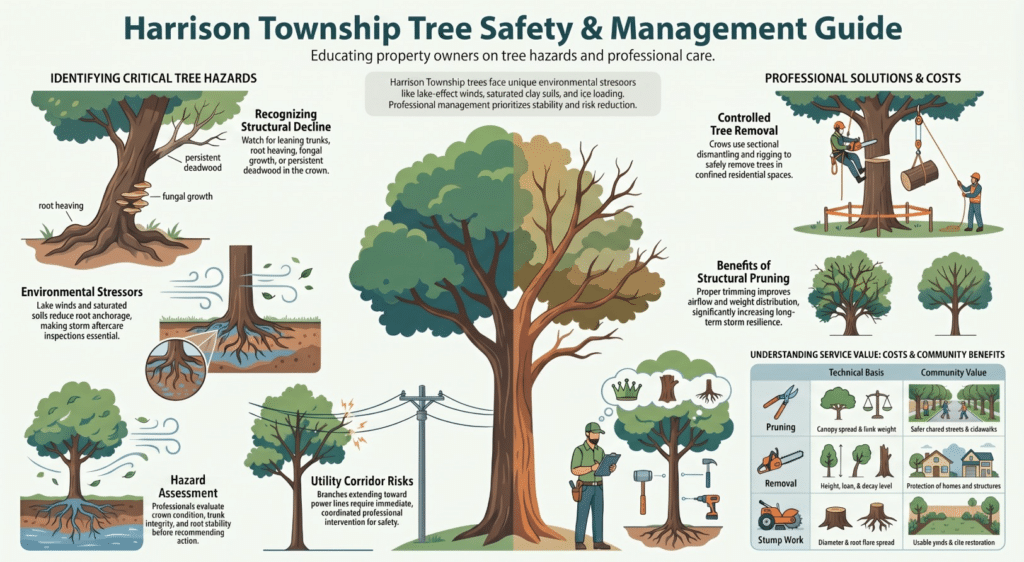
Knowing when to call a Harrison Township tree service can prevent property damage, reduce safety hazards, and protect the long-term health of trees. Property owners commonly seek assessment after high winds, heavy snow, or saturated soil conditions, when Storm aftercare is necessary to identify cracked limbs, trunk separation, or destabilized canopies.
A qualified evaluation is also appropriate when root damage appears after excavation, drainage changes, soil heaving, or vehicle compaction near the vital root zone.
Urgency increases when branches extend toward utility corridors, because power line safety requires trained personnel and coordinated procedures. Residents should also respond promptly to visible decay, including fungal growth, cavities, bark loss, soft wood, or persistent deadwood in the upper crown. Leaning trees, repeated limb failure, and sudden canopy thinning can indicate structural decline.
In a community where shared landscapes affect neighboring homes, timely inspection supports informed decisions, responsible stewardship, and safer outdoor spaces for everyone nearby.
Tree Services Available in Harrison Township
Tree services available in Harrison Township typically address structural risk, canopy management, and site clearance requirements. Tree removal services are used for dead, unstable, diseased, or obstructive trees where retention is not practical. Tree trimming options support clearance, crown balance, defect reduction, and long-term tree well-being.
Tree Removal Services
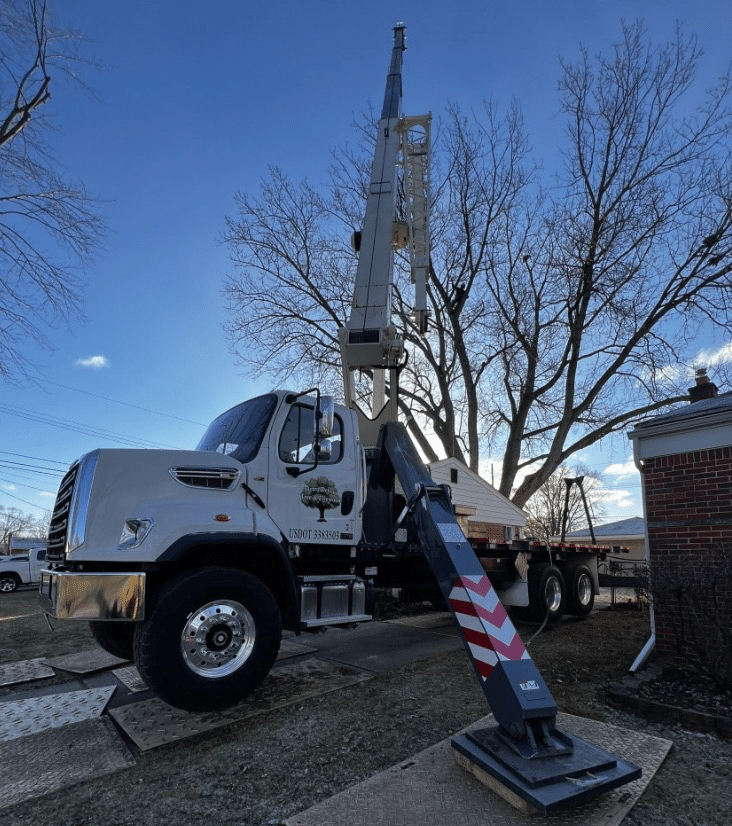
Professional tree removal in Harrison Township involves controlled dismantling methods, hazard assessment, and site-specific rigging to remove unstable, dead, diseased, or obstructive trees without damaging nearby structures, utilities, lawns, or hardscapes. Crews evaluate lean, decay, root plate movement, canopy load, access limits, and fall zones before selecting cranes, ropes, wedges, or sectional lowering systems.
Best practices include utility coordination, traffic control, protective ground mats, communication protocols, and debris containment that respects neighboring properties. In established lakeside and residential areas, removal planning helps preserve shared streetscapes and supports neighborhood cleanup after storms or decline-related failures.
Stumps, logs, brush, and chips may be hauled, processed, or staged in accordance with municipal requirements and site needs, leaving properties safer, more orderly, and ready for appropriate restoration.
Tree Trimming Options
After hazardous or unwanted removals are addressed, trimming becomes a primary method for managing structure, clearance, health, and risk in Harrison Township landscapes. Professional crews evaluate branch unions, canopy density, species response, and proximity to roofs, streets, utility lines, and neighboring properties before selecting cuts.
Crown shaping can improve symmetry while preserving natural form, reducing wind resistance, and limiting future limb failure. Clearance trimming supports safer sidewalks, driveways, signage, and shared community spaces without unnecessary canopy loss. Deadwood removal, selective thinning, and reduction cuts may be combined when defects or overextension are present.
A consistent pruning schedule helps residents protect mature trees, coordinate seasonal care, and maintain neighborhood character. Proper technique avoids topping, excessive removal, and bark injury, supporting long-term health and safer, more cohesive outdoor settings.
Harrison Township Emergency Tree Removal After Storm Damage
When severe weather compromises structural stability, emergency tree removal in Harrison Township, MI requires rapid hazard assessment, controlled dismantling, and safe debris management. Crews evaluate root plate movement, trunk fractures, split unions, lodged branches, utility conflicts, and access limitations before work begins. This disciplined process helps neighborhoods respond in unison while reducing exposure to hazards from fallen limbs near homes, driveways, sidewalks, and shared property lines.
Qualified personnel establish exclusion zones, determine rigging points, and use sectional removal methods when a tree cannot be felled safely in one piece. Cranes, aerial lifts, ropes, and lowering devices may be selected based on load distribution and surrounding structures. Debris is staged to preserve emergency access and minimize secondary damage.
Storm safety planning also supports faster decisions after an incident. Property owners who document tree locations, clearance concerns, and preferred contact procedures help service teams prioritize urgent risks and restore safe conditions with organized, community-focused efficiency after damaging storms.
How Harrison Township Weather Affects Trees
How does Harrison Township weather influence tree recovery and structural reliability? Local trees endure lake-effect winds, freeze-thaw cycles, humid summers, and periodic heavy rainfall. These conditions alter load distribution, root anchorage, and canopy balance. Saturated soils reduce friction around roots, especially where clay layers limit drainage. When soil moisture remains elevated, mature trees may lean or respond poorly to wind stress.
Winter conditions create additional mechanical strain. Repeated frost impact can expand existing cracks, heave shallow roots, and weaken branch attachments. Rapid temperature shifts may also stress bark and cambium, particularly on exposed south-facing trunks. In summer, heat and humidity increase water demand while compacted urban soils restrict oxygen exchange.
For Harrison Township neighborhoods, routine structural evaluation helps preserve a shared landscape that feels safe, established, and cared for. Arborists consider exposure, species tolerance, grade changes, and drainage patterns when recommending pruning, cabling, or soil improvements that support long-term stability before weather turns severe.
Signs Your Harrison Township Tree May Be Diseased
Although symptoms vary by species and pathogen, diseased trees in Harrison Township often show early warning signs in foliage, bark, branching, and root-zone conditions. Shared awareness helps property owners recognize problems before the decline spreads through valued neighborhood canopies.
Early recognition of tree diseases helps Harrison Township property owners protect the neighborhood canopy’s health.
- Leaf discoloration, premature leaf drop, spotting, or marginal scorch may indicate vascular stress, nutrient disruption, or foliar infection.
- Fungal growth on trunks, root flares, or exposed roots can signal internal decay, compromised structural wood, or excessive moisture retention.
- Cracked bark, sunken cankers, dead twigs, sparse canopy density, or oozing sap often reflects pathogen activity or impaired transport tissues.
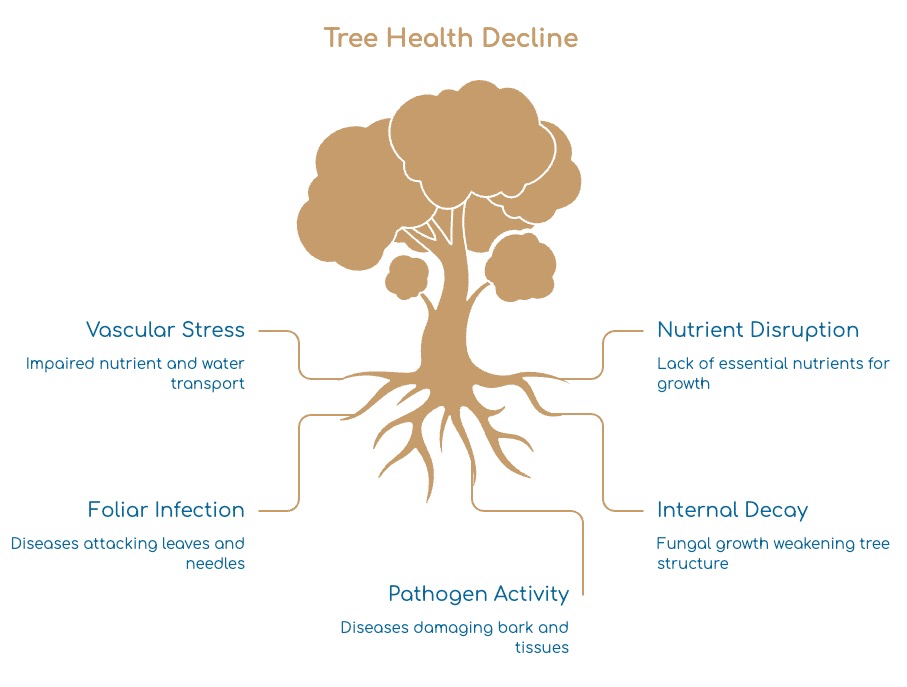
Root-zone clues also matter. Soil heaving, chronic saturation, girdling roots, and reduced annual shoot growth can accompany disease progression. Because insects, drought stress, and mechanical injury may mimic infection, accurate diagnosis usually requires species identification, site history, and close inspection of symptom patterns.
Prompt evaluation supports safer yards, healthier streetscapes, and coordinated stewardship across the Harrison Township community.
Tree Trimming in Harrison Township
Tree trimming in Harrison Township supports essential structural stability, seasonal clearance, and reduced storm-related branch failure. Proper branch removal targets dead, crossing, or overextended limbs while preserving the tree’s natural growth pattern. When performed at the correct time of year, trimming promotes healthier canopy development and improved long-term robustness.
Seasonal Trimming Benefits
Seasonal trimming in Harrison Township supports structural integrity, canopy balance, and long-term tree wellness by aligning pruning work with species-specific growth cycles and local weather conditions. During the Dormant season, reduced sap flow and clearer branch architecture allow arborists to evaluate form with accuracy while limiting stress responses.
An annual inspection helps identify density issues, rubbing limbs, and early decline before they affect neighborhood canopy continuity.
- Encourages controlled spring growth by directing resources toward the stable development of the scaffold.
- Improves light penetration and airflow, supporting turf, understory plantings, and shared property aesthetics.
- Reduces seasonal pest and disease pressure by removing compromised growth at biologically appropriate times.
For Harrison Township properties, scheduled trimming creates predictable maintenance cycles and helps residents preserve a healthy, cohesive landscape character across the year.
Safe Branch Removal
When branches overextend, crack, or interfere with structures, safe branch removal in Harrison Township requires controlled cutting methods that account for load distribution, attachment strength, and surrounding targets. Crews assess branch hazards by identifying included bark, decay pockets, storm fractures, and tension points before any cut is made.
A safety checklist supports consistent decisions: establish drop zones, inspect rigging points, confirm tool condition, protect utilities, and maintain communication among workers. Proper sequencing often uses reduction cuts, relief cuts, and final collar cuts to prevent bark tearing and uncontrolled release. In neighborhood settings, this disciplined approach helps residents feel confident that shared streets, yards, and property lines are respected.
Safe removal limits immediate risk while preserving structural integrity for routine tree trimming operations. This practice supports reliable local tree-care standards.
Healthier Tree Growth
Through selective canopy management, tree trimming in Harrison Township promotes regenerative growth by improving light penetration, air movement, and structural balance within the crown. Skilled pruning reduces competition among limbs, directs energy toward strong scaffold branches, and supports long-term vigor in community landscapes.
- Enhances photosynthetic efficiency by opening dense foliage without over-thinning.
- Supports disease prevention by removing infected, crowded, or moisture-trapping branches.
- Improves storm resilience through balanced weight distribution and corrected branch spacing.
Regenerative growth also depends on integrated cultural practices. Soil nutrition should be assessed to correct deficiencies that limit canopy response. Proper mulching moderates soil temperature, conserves moisture, and protects feeder roots from mechanical injury.
When needed, root pruning can manage conflicts while preserving stability and shared neighborhood value.
Harrison Township Tree Pruning for Long-Term Tree Health
For mature and developing trees in Harrison Township, MI, structural pruning is a preventive maintenance practice that improves branch architecture, reduces mechanical stress, and supports long-term health. Proper cuts guide central leader development, improve branch spacing, and reduce the risk of codominant stems that may weaken under seasonal wind, snow, or canopy weight. In residential and community landscapes, this creates safer, more balanced growth while preserving the character residents value.
Professional pruning also supports disease diagnosis by exposing symptoms such as cankers, dieback, fungal fruiting bodies, or abnormal leaf density. Selective removal of compromised limbs can improve air circulation and light penetration without over-thinning the canopy. Pruning scheduling is typically based on species biology, growth rate, site conditions, and pest pressure, helping avoid unnecessary stress during vulnerable periods.
When performed with clean tools, proper collar cuts, and species-specific objectives, pruning becomes a long-term care strategy that helps Harrison Township trees remain healthy, stable, and well-integrated.
Safe Removal for Harrison Township Hazardous Trees
Safe removal for hazardous trees begins with a structured hazard assessment that identifies structural defects, lean, decay, root instability, and proximity to targets. In Harrison Township, MI, site conditions such as soil saturation, wind exposure, and confined work zones influence the removal method. Controlled tree removal uses rigging, sectional dismantling, and load management to reduce risk to people, structures, and surrounding landscape features.
Hazard Assessment
When does a damaged or declining tree become a removal risk rather than a manageable defect? In Harrison Township, hazard assessment begins with structured risk evaluation, not guesswork. Qualified tree professionals examine visible defects, site exposure, and likely targets, helping property owners feel informed and protected.
- Crown condition: dead limbs, split unions, decay pockets, and overhead hazards above homes, drives, sidewalks, or service lines.
- Trunk integrity: cavities, fungal fruiting bodies, included bark, cracks, and abnormal lean indicating compromised load capacity.
- Root stability: soil heaving, severed roots, saturated ground, or construction damage reducing anchorage.
Findings are weighed against occupancy, weather exposure, and failure likelihood. This technical review supports responsible decisions, aligns neighbors around shared safety expectations, and identifies when removal should be considered before failure occurs.
Controlled Tree Removal
After a hazard assessment confirms unacceptable failure potential, controlled tree removal uses planned rigging, sectional dismantling, and site protection measures to reduce risk around structures, utilities, hardscapes, and occupied areas. Crews may isolate load paths, account for diseased bark, root damage, lean, wind exposure, and landing constraints, then remove the tree in manageable sections.
In Harrison Township, this disciplined approach helps neighbors maintain safe shared surroundings.
| Zone | Action | Visual Cue |
| Crown | Lower limbs by rope | Branches descending slowly |
| Trunk | Cut sections sequentially | Wood rounds guided downward |
Cutting plans consider compression, tension, hinge wood, and crane or rigging capacity. Ground protection, traffic control, and debris staging keep the worksite orderly, limiting impact while preserving confidence among nearby residents.
Harrison Township Stump Grinding and Stump Removal Options
Although a felled tree may appear resolved at ground level, the remaining stump and root flare can obstruct grading, mowing, drainage, and future planting plans. In Harrison Township properties, stump grinding and full stump removal offer different levels of site restoration depending on soil conditions, root spread, and intended land use. Grinding reduces the stump below grade with a rotating cutting wheel, leaving chips that may support landscape cleanup when managed properly.
Full removal extracts the stump and major roots, creating a cleaner excavation for construction, utilities, or replanting.
- Grinding suits lawns where minimal disturbance and improved stump aesthetics are priorities.
- Removal is appropriate when roots interfere with hardscape, drainage lines, or the placement of new trees.
- Backfilling, compaction, and surface leveling help return the area to safe shared use.
A qualified crew evaluates access, underground conflicts, and debris handling so the finished space aligns with neighborhood standards and practical maintenance needs.
Tree Service Costs in Harrison Township
Because tree work varies by site conditions, tree service costs in Harrison Township are typically influenced by tree size, species, structural condition, access limitations, equipment needs, disposal requirements, and proximity to buildings, utilities, roads, or waterfront features.
Local crews commonly evaluate tree height factors and trunk diameter pricing to classify labor intensity, rigging complexity, and haul-away volume.
| Cost Element | Technical Basis | Community Value |
| Pruning | Canopy spread, limb weight | Safer shared streets |
| Removal | Height, lean, decay | Protected homes |
| Stump Work | Diameter, root flare | Usable yards |
Smaller ornamental trees may require limited climbing and light debris processing, while mature maples, oaks, cottonwoods, or storm-damaged trees often require sectional dismantling, cranes, or controlled lowering systems. Pricing is usually presented after inspection, not by guesswork, so residents receive estimates aligned with neighborhood conditions, municipal expectations, and accepted arboricultural practice. Clear scope definitions help households compare services responsibly.
What Changes Your Tree Service Estimate
Estimate variables change when field conditions alter labor time, equipment selection, risk exposure, or disposal volume. In Harrison Township, crews assess site mechanics before finalizing scope because small differences can shift production planning and safety controls.
- Limited access may require compact loaders, hand-carry removal, or staged rigging near fences, docks, garages, and neighboring properties.
- Tree condition affects climbing, cutting sequence, and load calculations, especially after decay, storm stress, or the discovery of hidden damage.
- Debris volume changes hauling, chipping, landfill fees, and cleanup time when large crowns, heavy wood, or tangled brush are present.
Common tree service pricing factors include tree height, trunk diameter, lean direction, proximity to utilities, soil saturation, and whether traffic control is needed. Emergency response, frozen ground, and shoreline exposure can also influence scheduling and equipment deployment. A detailed estimate reflects shared expectations, giving property owners and service teams a clear operational plan before work begins.
Choosing a Harrison Township Tree Company
After pricing variables are understood, the next decision is selecting a Harrison Township tree company capable of matching the work conditions with proper methods, equipment, and risk controls. A qualified provider aligns field techniques with neighborhood safety expectations, shoreline soil conditions, proximity to utilities, and municipal standards.
| Selection Factor | Technical Importance |
| Local licensing | Confirms compliance with township and county requirements |
| Insured crew | Protects residents, workers, and adjacent properties |
| Equipment capacity | Matches removals, pruning height, and access limits |
| Pricing comparisons | Clarifies scope differences, not just totals |
| Service guarantees | Defines workmanship accountability after completion |
The strongest company profile includes documented safety procedures, trained climbers or lift operators, controlled rigging practices, and debris handling suited to compact residential lots. Consistent communication also helps residents feel aligned with a dependable local resource rather than an unfamiliar contractor. In Harrison Township, selection should favor measured capability, verified coverage, and clear performance standards over availability alone.
Questions to Ask a Local Harrison Township Tree Pro
Which questions reveal whether a Harrison Township tree professional can perform the work safely, legally, and efficiently? Homeowners can evaluate competence by asking direct, job-specific questions before any saws, lifts, or rigging enter the property. Strong answers create shared confidence between the client, crew, and neighborhood.
Ask job-specific questions early to confirm a Harrison Township tree professional can work safely, legally, and efficiently.
- What tree pro credentials does the company hold, including ISA certification, pesticide licensing, or municipal registration?
- Can it provide current liability and insurance documentation, workers’ compensation coverage, and proof that subcontractors are covered?
- How will the crew control drop zones, utility conflicts, traffic exposure, stump removal, debris handling, and site restoration?
A qualified provider should explain pruning standards, removal methods, equipment selection, and emergency procedures in clear terms. Written estimates should identify scope, exclusions, disposal, permits, and timing. If hazards involve power lines, decay, storm damage, or limited access, the tree pro should document the risk assessment before work begins.
Professional tree service in Harrison Township, MI supports property safety, tree health, and long-term risk control.
Proper pruning, structural assessment, storm response, tree removal, stump grinding, and debris management help reduce hazards near homes, utilities, driveways, and commercial sites.
Weather exposure, disease, decay, and root instability should be evaluated by qualified crews using safe work practices.
A licensed, insured tree company such as Metro Detroit Tree & Firewood provides accurate estimates, appropriate equipment, and compliant removal methods for both routine maintenance and emergency conditions.
Call Us Now: 568-625-3398
Get Your FREE Quote Now From Our Tree Service In Harrison Township MI
To get a free quote by our owner on Wednesdays, Saturdays, or Sundays, contact us today at (586) 625-3398.
- Tree Service in Warren MI
- Tree Service in Roseville MI
- Tree Service in Fraser MI
- Tree Service in Utica MI
- Tree Service in Sterling Heights MI
- Tree Service in St. Clair Shores MI
- Tree Service in Macomb Township MI
- Tree Service in Harper Woods MI
- Tree Service Washington Township MI
- Tree Service in Shelby Township MI
- Tree Service in Richmond MI
- Tree Service in Clinton Township MI
- Tree Service in Chesterfield MI
- Tree Service in Romeo MI
- Tree Service in New Baltimore MI
- Tree Service in New Haven MI