Tree Service in New Baltimore MI. Emergency Tree Service and More
Tree service in New Baltimore, MI starts with a site-specific assessment of tree structure, soil conditions, clearance zones, and storm exposure.
Metro Detroit Tree & Firewood inspects canopy weight, trunk defects, root stability, and proximity to roofs, drives, sidewalks, and utility paths.
Pruning, removal, stump grinding, and emergency response each require different controls.
The right decision depends on the risk level, access, and long-term property use, and a single overlooked defect can change the plan. Call us for tree service in Macomb County.
Main Takeaways
- A local tree service in New Baltimore, MI, should start with an inspection, species evaluation, trunk integrity review, and canopy risk assessment.
- Tree trimming should improve structure, remove deadwood, reduce end weight, and maintain clearance from roofs, walks, driveways, and utilities.
- Hazardous tree removal requires planning for lean, decay, drop zones, rigging needs, equipment access, and protection of nearby property.
- Storm damage response should prioritize life safety, hazard stabilization, utility verification, limb extraction, and coordinated debris cleanup.
- Choose a tree company with licensing, insurance, a written scope, proper equipment, safety protocols, references, and clear cleanup standards.
What New Baltimore Tree Service Includes
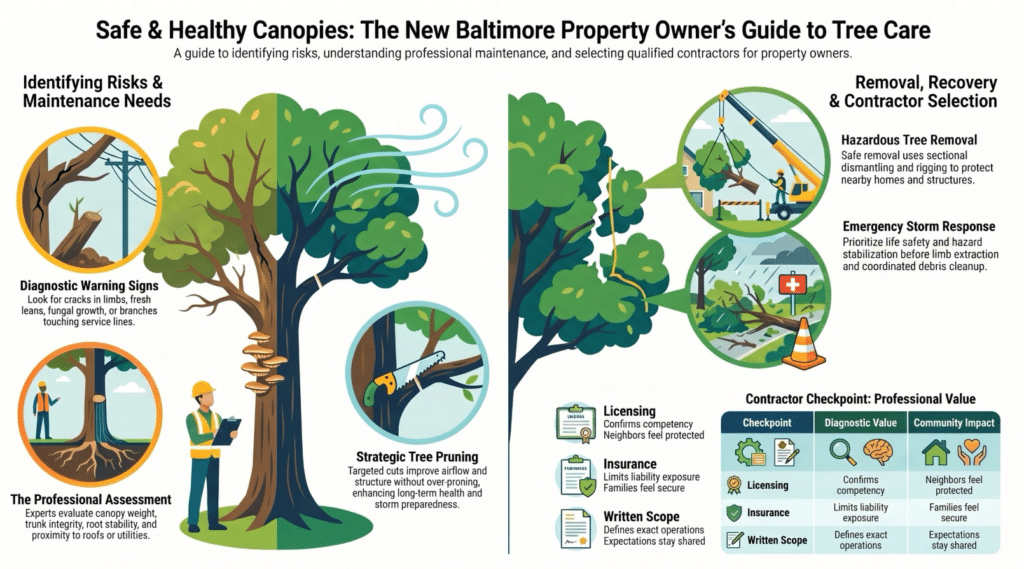
When evaluating a tree service in New Baltimore, MI, the scope typically includes inspection, pruning, removal, stump grinding, storm-damage response, and plant health assessment. Providers assess species, trunk integrity, canopy load, root exposure, soil compaction, clearance conflicts, and site access before defining work limits. Pruning may address structural balance, deadwood reduction, utility clearance, or clearance over roofs, walks, and driveways.
Removal planning considers lean, decay, drop zones, rigging requirements, equipment staging, and debris handling. Stump grinding reduces residual trip hazards and prepares the area for restoration. Storm response may include limb extraction, temporary hazard control, and coordinated cleanup. Plant health services often involve pest identification, disease evaluation, nutrient review, and monitoring recommendations.
Consultation scheduling helps residents coordinate assessments within shared neighborhood routines. Documentation may support homeowner insurance when damage, liability, or claim verification is involved, aligning technical findings with community expectations for safe, orderly properties.
Signs You Need a Local New Baltimore Tree Service
How can a property owner identify the point at which routine observation should become a professional tree evaluation? Diagnostic signs often appear as structural changes, site disturbances, or conflicts with shared community standards.
Tree concerns become evaluation priorities when visible defects suggest risk, instability, or community impact.
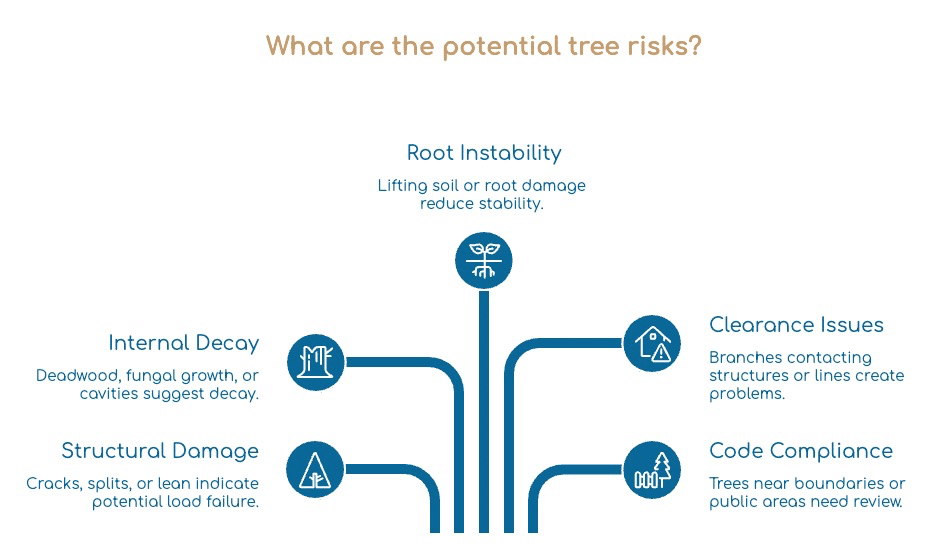
- Cracks in major limbs, split unions, or fresh lean after storm damage indicate potential load failure.
- Deadwood, sparse canopy sections, fungal growth, or cavities may indicate internal decay that requires a tree risk assessment.
- Roots lifting soil, damaging pavement, or being severed by excavation can reduce stability and affect nearby infrastructure.
- Branches contacting roofs, service lines, sidewalks, or streets may create clearance issues tied to local regulations.
- Declining trees near property boundaries, public access areas, or drainage routes may require code compliance review.
In New Baltimore, these indicators are not merely cosmetic. They affect neighborhood safety, utility access, and the orderly appearance residents expect. A local tree service can document conditions, identify urgency, and help determine whether pruning, removal, or monitoring is appropriate.
How to Choose a New Baltimore Tree Service Company
Why does contractor selection matter after tree defects are identified? Selection determines whether risk is reduced or merely transferred. A qualified company documents site conditions, load paths, targets, access limits, and disposal requirements before pricing. New Baltimore property owners often look for a crew that protects both the block and the yard.
A licensed arborist should verify species, decay indicators, root-zone disturbance, and failure probability. Insured workmanship should be confirmed through current certificates, not verbal assurance.
| Checkpoint | Diagnostic Value | Community Impact |
| Licensing | Confirms arboricultural competency | Neighbors feel protected |
| Insurance | Limits liability exposure | Families feel secure |
| Written scope | Defines exact operations | Expectations stay shared |
| Equipment review | Matches machinery to site constraints | Streets remain respected |
The chosen provider should offer clear estimates, safety protocols, references, and cleanup standards. Low bids without credentials may signal hidden exposure. Proper vetting keeps one property aligned with the wider neighborhood’s safety culture.
Tree Trimming in New Baltimore, MI
Because canopy growth affects clearance, structure, and load distribution, tree trimming in New Baltimore should begin with a diagnostic assessment rather than a generic cutback. A qualified crew evaluates species, growth rate, branch unions, proximity to utilities, and site exposure before selecting cuts that support shared neighborhood safety and long-term canopy health.
- Identify crossing, rubbing, or overextended limbs that alter structural balance.
- Thin dense interior growth to improve airflow, light penetration, and disease prevention.
- Establish clearance from roofs, sidewalks, driveways, and service lines without over-pruning.
- Reduce end weight on selected limbs to improve storm preparedness during lake-effect winds.
- Preserve natural form with targeted cuts made outside the branch collar.
This measured approach helps residents maintain trees that fit their properties and the wider streetscape. Proper trimming also limits stress response, reduces weak regrowth, and supports predictable maintenance cycles for New Baltimore homes, associations, and commercial sites year-round.
Safe Removal for New Baltimore Dead or Hazardous Trees
Dead or hazardous tree removal begins with a structural risk assessment that includes trunk decay, root instability, canopy dieback, and proximity to targets. Safe removal methods are selected based on lean, access, load distribution, rigging requirements, and site constraints.
Emergency removal planning addresses storm damage, partial failures, utility conflicts, and the controlled sequencing of responses.
Identifying Hazardous Tree Risks
When structural defects progress beyond normal tolerance, a tree can shift from a landscape asset to a measurable safety hazard. In New Baltimore communities, Tree Inspections support shared confidence by documenting defects before failure occurs. A qualified Risk Assessment evaluates condition, target exposure, and probable consequences.
- Deadwood over walkways, roofs, drives, or play areas
- Trunk cavities included bark, cracks, or seam separation
- Root plate lifting, soil heaving, fungal conks, or decay pockets
- Lean changes, canopy imbalance, storm loading, or saturated soil
- Branch unions with compression weakness or prior tear-out wounds
Diagnostic findings should be recorded with photos, measurements, and site context. This process helps property owners, neighbors, and managers align on urgency, liability control, and next steps without speculation or delay.
Safe Tree Removal Methods
Once a hazardous tree is confirmed unsuitable for retention, safe removal begins with a controlled work plan that accounts for defect location, load distribution, access constraints, and nearby targets. Crews assess Tree Health indicators, stem stability, and canopy weight before selecting sectional dismantling, directional felling, or rigging.
| Condition | Method | Control Focus |
| Dead crown | Sectional cuts | Drop zone |
| Leaning stem | Guided felling | Hinge wood |
| Decayed trunk | Rigging | Load path |
| Tight access | Climbing removal | Anchor points |
Each cut is sequenced to reduce torsion, barber-chair risk, and unintended swing. Ropes, blocks, and friction devices manage energy transfer while protecting nearby homes, fences, and shared spaces. Professional Safety depends on exclusion zones, communication signals, verified equipment, and crew roles aligned before cutting starts.
Emergency Removal Planning
During an emergency tree removal, planning starts with rapid hazard triage: identifying active failures, compromised root plates, split unions, hung limbs, utility conflicts, and occupied target zones. Crews convert observations into a shared site plan, so every resident, responder, and worker understands the controlled removal sequence.
- Document storm damage, lean direction, decay columns, and load paths.
- Establish exclusion zones based on drop radius and escape routes.
- Verify utility proximity before rigging, cutting, or equipment placement.
- Apply tree stabilization when movement could trigger secondary failure.
- Complete risk assessment for access, traffic, structures, and weather.
The plan prioritizes life safety, then property protection, then debris workflow. Dead or hazardous trees are sectioned only after the forces are isolated. This disciplined process helps New Baltimore neighborhoods recover with confidence alongside.
New Baltimore Stump Grinding and Tree Debris Cleanup
Stump grinding and tree debris cleanup complete the removal process by reducing trip hazards, limiting pest habitat, and restoring usable ground surface. In New Baltimore, technicians assess stump diameter, root flare exposure, soil grade, and nearby utilities before selecting grinder depth and access path. Grinding typically reduces the stump below grade, allowing the area to accept topsoil, seed, mulch, or future landscape installation without unstable voids.
Debris cleanup is evaluated with the same level of attention. Brush, chips, logs, and residual sawdust are sorted for hauling, recycling, or controlled onsite reuse. When removals follow hazardous limb removals or corrective pruning for storm-damage prevention, cleanup confirms that cracked branches, embedded fragments, and unstable wood are no longer present around lawns, drives, fences, or shared walkways.
This organized finish helps a property rejoin the neighborhood standard: safe circulation, clean edges, and predictable maintenance conditions. Proper disposal also reduces fungal reservoirs and wood-boring insect activity near healthy trees and structures.
Emergency Tree Service After New Baltimore, Michigan Storms
After routine debris cleanup, severe Michigan weather can create a different service priority: rapid hazard control. In New Baltimore, emergency tree service focuses on stabilizing sites where Storm damage threatens homes, driveways, utilities, and shared neighborhood access. Crews evaluate load paths, fracture points, root plate movement, and overhead tension before cutting begins.
Storm response begins with a controlled hazard assessment before any cutting, clearing, or recovery work moves forward.
- Rapid response prioritizes blocked roads, damaged roofs, and compromised service lines.
- Fallen-limb assessment identifies risks of compression, splitting, hanging wood, and secondary failure.
- Safe access planning establishes work zones, escape routes, equipment staging, and pedestrian exclusion.
- Structural inspection determines whether pruning, sectional removal, or full extraction is required.
- Final clearance verifies that remaining stems, canopy sections, and debris fields are stable.
This disciplined process helps residents move from disruption toward coordinated recovery. Each property is treated as part of the wider local environment, where timely hazard reduction supports safer homes, connected streets, and community confidence after storms pass through Macomb County.
Tree Service Costs in New Baltimore, MI
Why do tree service costs in New Baltimore, MI, vary so widely? Pricing depends on measurable site conditions: tree height, trunk diameter, canopy spread, species density, decay indicators, proximity to utilities, equipment access, and debris volume. A small ornamental removal with clear access differs sharply from a compromised oak leaning over a garage or service line.
Local crews typically evaluate labor hours, rigging complexity, disposal requirements, stump grinding depth, and risk exposure before issuing a quote. Preventive work, such as seasonal pruning, often costs less than corrective cutting because hazards are identified before structural failure occurs. After severe weather, a storm damage assessment helps classify urgency, determine load instability, and separate salvageable limbs from removal candidates.
Residents share the same lakeshore winds, clay soils, and freeze-thaw stressors, so fair estimates should reflect local conditions rather than generic rates. Detailed written scopes help property owners compare services confidently and keep neighborhood tree care consistent, safe, and fiscally predictable.
Tree service in New Baltimore, MI requires site-specific assessment, risk classification, and controlled execution by Metro Detroit Tree & Firewood. Proper inspection identifies structural defects, canopy imbalance, clearance conflicts, storm damage, and indicators of decay before pruning, removal, stump grinding, or emergency response begins.
Qualified crews use appropriate equipment, follow safety protocols, and manage debris to protect structures, utilities, sidewalks, and driveways. Routine evaluation and timely intervention help reduce the potential for failure, improve site safety, and maintain functional, stable landscapes.
Get Your FREE Quote Now From Our Tree Service In New Baltimore MI
To get a free quote by our owner on Wednesdays, Saturdays, or Sundays, contact us today at (586) 625-3398.
- Tree Service in Warren MI
- Tree Service in Roseville MI
- Tree Service in Fraser MI
- Tree Service in Utica MI
- Tree Service in Sterling Heights MI
- Tree Service in St. Clair Shores MI
- Tree Service in Macomb Township MI
- Tree Service in Harper Woods MI
- Tree Service Washington Township MI
- Tree Service in Shelby Township MI
- Tree Service in Richmond MI
- Tree Service in Clinton Township MI
- Tree Service in Chesterfield MI
- Tree Service in Romeo MI
- Tree Service in Harrison Township MI
- Tree Service in New Haven MI